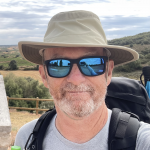
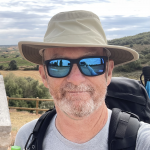
In the reflective morning haze of Champions Gate, Florida, where the January sun climbs at 7:15 AM EST and paints the world in golden possibility, I sit with my journal—same root as "journey," a reminder that wandering and writing are kin.
It's January 18, 2026, and more than three years have slipped by since my 2022 Camino de Santiago. That trail transformed me, reshaping my soul like the Meseta's winds and Galician rain carve the earth.
Yet, for all that meaty material—blisters as metaphors, thresholds crossed in rain-soaked defiance, epiphanies under starry Galician skies—I can't seem to write the damn memoir. No closure, no tidy epilogue. Why?
The Camino isn't just a path; it's life's blueprint, a living metaphor for the absurd flux we navigate. Camus would nod—our craving for meaning clashes with the universe's indifferent silence, demanding revolt through continued steps.
If I "close out" my 2022 walk, penning it as a finite chapter, does that signal the end of my pilgriming? In a way, yes—and that terrifies me. To stop journeying feels like symbolic death, a surrender to the grind mode I escaped pre-Camino: that self-reliant hustle, chained to desks and deadlines, where power-wills dominated over grace-led flow.
Writing the memoir would mean halting the loop I described in "Moving Thresholds"—those liminal spaces where transformation hums eternally. I'd have to step off Jacob's Ladder, trading enactive ascent for static reflection.
Deeper still, I'm changing daily. If it takes 90 days to draft the darn book, what I capture on day 1 won't align with day 90's Lance. I've proven this over and over with each writing start. My views continue to evolve—wrestling to yield to the Cloud of Unknowing, a concept I learned well after walking into Santiago, yet it explains so much of the emotional and spiritual terrain from Saint Jean Pied de Port forward.
The Camino subsumed my Stoic discipline into a participatory grace loop I do not want to step away from. Each time I sit down to write my Camino story, I see clearly how I'm morphing it mid-telling, echoing "Omnia Mutantur, Nihil Interit"—things change, but essence endures. My writing is like trying to step into the same river twice.
And forcing the writing feels like it risks commodifying what was powerfully sacred for me, turning my Covid-tyranny revolt into a product for fame or fortune. As Pieper warns in Leisure: The Basis of Culture, true insight blooms in non-activity, not grind that seeks honor, fame, and fortune.
This morning, I reframe my resistance not as blockage but as wisdom. My blog already memoirs the Camino in fragments—Meseta love and loss, post-Camino flips, sacred wagers. It has kept my pilgrim's vector alive. Perhaps closure's another illusion of this disorientingly dull Matrix I've come to see more clearly?
Maybe real pilgrimage defies endpoints.
As I ponder all this mind junk in my verdant Central Florida post-holiday calm, I recognize I'm still in the arena, still stepping across a seemingly endless array of next thresholds.
So I revolt onward. Buen Camino, friends.
~Lance v22,790, 3,255.7 weeks and still living the dream.
References
Anonymous. (2001). The cloud of unknowing (J. Walsh, Ed.). Paulist Press. (Original work published ca. 1370)
Camus, A. (1955). The myth of Sisyphus (J. O'Brien, Trans.). Vintage Books. (Original work published 1942)
Ovid. (2004). Metamorphoses (D. Raeburn, Trans.). Penguin Classics. (Original work published 8 AD)
Pieper, J. (1998). Leisure: The basis of culture (A. Dru, Trans.; with an introduction by T. S. Eliot). Ignatius Press. (Original work published 1952)